Baratza Encore vs Encore ESP: Which Is Better? (October 2026)
The Baratza Encore vs Encore ESP choice comes down to your brew method: choose the Encore for filter-first brewing or the ESP for regular espresso. The ESP's smaller espresso adjustment steps give you more control when dialing in a shot.
On this page (9 sections)
- Baratza Encore vs Encore ESP: which is better for espresso?
- Which grinder should you choose for filter coffee?
- Does the ESP make sense if you switch brew methods?
- What changes in everyday dosing and counter use?
- How should you set up either grinder?
- Which cleaning differences matter?
- What do the burrs, warranty and scores tell you?
- What mistakes should you avoid before and after buying?
- Baratza Encore vs Encore ESP: final pick
The Baratza Encore vs Encore ESP decision starts with your main brew method: choose the Encore for filter-first brewing and the Encore ESP for regular espresso. The ESP's smaller espresso adjustment steps matter most when you need to change how a shot flows.
Both can serve more than one brewing method, so this isn't a choice between a filter-only grinder and an espresso-only grinder. It's a choice about where you need the most control.
Think about the coffee you'll make most mornings, plus any brewing changes you actually plan to make. A vague interest in espresso deserves less weight than an espresso machine already on your counter.

Baratza Encore vs Encore ESP: which is better for espresso?
The Encore ESP is the stronger espresso choice because it offers smaller changes between settings in the espresso range. Those changes help when one grind setting lets water through too quickly and the next slows it too much.
Espresso depends on water passing through a compact bed of coffee under pressure. Grind size changes the bed's resistance, which affects flow and extraction.
A grinder can reach a fine texture yet still leave you wanting a setting between 2 positions. That's why espresso buyers should care about adjustment spacing as well as the finest available grind.
The original Encore supports espresso among its brew methods. However, someone buying mainly for espresso should choose the model whose adjustment system was designed around that task.
Your basket matters, too. A pressurized basket creates some resistance itself and is generally more forgiving of grind variation, while a nonpressurized basket relies more heavily on the coffee bed.
If your machine uses a nonpressurized basket, prioritize fine adjustment from the start. Even an occasional weekend espresso routine can justify the ESP when getting the shot right matters to you.
For the brewing basics, read what grind size is best for espresso. Our Baratza Encore espresso guide explains where the original model fits.
Baratza Encore vs Encore ESP: what does dual-range adjustment mean?
The Encore ESP divides its 40 positions into 2 adjustment ranges: micro-steps from #1–20 for espresso and macro-steps from #21–40 for filter brewing. The original Encore has 40 settings across its brewing range.
The total number of positions doesn't tell you how much control a grinder offers for a particular method. What matters is how closely those positions are spaced where you brew.
Don't compare the same setting number across the 2 models as though it means the same grind size. Treat each grinder's numbers as reference points for that grinder.
Which grinder should you choose for filter coffee?
The Encore is the practical pick for a filter-only household, while the ESP makes sense if espresso shares the counter. Choose around your brewing plans rather than assuming the espresso-focused model must make better drip coffee.
The Encore covers AeroPress, Hario V60, Chemex, French press and automatic brewers. That range suits someone who wants to explore home coffee without building a routine around espresso.
For filter brewing, first establish a repeatable recipe. Keeping the coffee dose and water amount steady makes grind changes easier to judge.
With pour-over, a finer grind generally slows water movement through the coffee bed, while a coarser grind generally speeds it up. Filter type, pouring technique and the amount of coffee also affect drawdown.
French press uses immersion rather than water draining through a filter bed. Don't judge its grind by pour-over timing; pay attention to flavor, sediment and how easily you plunge without forcing it.
Use our Baratza Encore grind settings guide for starting points. The coffee grind size chart helps explain the differences between methods.
Skip the Encore if espresso is already your next firm step. Buying around today's drip brewer alone can leave you wanting finer adjustment as soon as your brewing routine changes.
Does the ESP make sense if you switch brew methods?
The ESP suits a household that regularly makes espresso and filter coffee, but switching methods still takes care. A saved setting gets you back to a starting point, not a guaranteed recipe.
Different beans can need different settings even when the brew method stays the same. Roast, coffee age and your chosen dose all affect how a recipe behaves.
Keep a short note for each method: bean, setting, coffee dose and water amount or espresso yield. Add a brief taste note so you know why you changed something.
Grinders can also hold some grounds inside after a dose. When moving between very different grind sizes, account for that carryover using the procedure in the grinder's instructions.
If 2 people share the grinder, agree on where to record settings. A grinder left at an espresso setting can disrupt the next person's morning drip batch.
Skip the ESP if you only make filter coffee and have no clear espresso plans. Its main advantage solves an espresso adjustment problem, so it needn't decide a filter-only purchase.
What changes in everyday dosing and counter use?
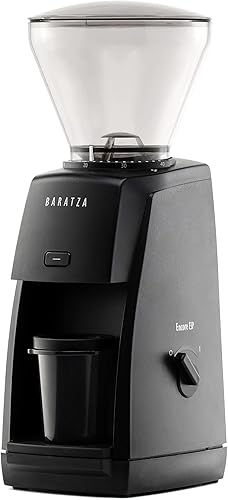
The controls are similar, but the ESP adds a choice between a grounds bin and an espresso dosing cup. Both models use a hopper twist, front-mounted pulse button and on/off switch.
The bin suits collecting grounds for a larger brew. The ESP's dosing cup gives espresso users a way to transfer grounds into a portafilter.
A dosing cup doesn't replace measuring your coffee. For repeatable espresso, weigh the grounds going into the basket rather than assuming the same grinding time always gives the same dose.
For filter coffee, you can weigh a batch of beans before grinding and compare the grounds collected. Follow the grinder's instructions when running it with a small measured dose.
Both grinders measure 5.91 x 5.12 x 13.39 in and weigh 5.6 lb, so neither has a size advantage. Check the space above the grinder as well as the space it occupies.
You'll need room to add beans, turn the hopper and access parts for care. A shelf that barely clears the grinder's height can make those jobs awkward.
These are manually controlled grinding routines. If your priority is a grinder that automatically stops at a chosen ground-coffee weight, neither model's pulse button or switch meets that need.
How should you set up either grinder?
Start with the correct assembly, a measured dose and one brew recipe. Changing several variables before your first useful cup makes it harder to know what needs fixing.
Read Baratza's instructions for your exact model before fitting parts or changing settings. Pay particular attention to the directions for moving toward a finer grind when beans are present.
Set the grinder on a stable, dry surface with easy access to the controls. Position the grounds container before starting so coffee doesn't spill onto the counter.
Choose one familiar coffee for the first few brews. Switching beans while learning the grinder adds another variable without helping you understand the adjustment.
For filter coffee, fix the dose and water amount, then change the grind in small steps. Keep your pouring or steeping routine similar while comparing cups.
For espresso, use a dose suited to your basket and keep the target beverage yield steady. Adjust grind size before changing the dose, yield and preparation technique together.
Dial in espresso with a repeatable routine
Use shot flow and taste together to guide adjustment. A shot that runs quickly and tastes thin or sharply sour may need a finer grind, provided dose and puck preparation are consistent.
A shot that barely flows may need a coarser grind. Stop and reassess rather than repeatedly forcing a shot through a setup that isn't flowing.
Uneven flow can also come from uneven coffee distribution in the basket. Make the bed level and tamp consistently before deciding that every poor shot needs a new grind setting.
Record what changed after each adjustment. Our Encore ESP review provides more detail on choosing this model for an espresso routine.
Which cleaning differences matter?
The ESP's quick-release burr mount gives it the clearer maintenance advantage. Baratza designed it for burr removal without extra tools or taking the whole grinder apart.
Easier access is useful because coffee oils and loose grounds collect inside a grinder. Cleaning removes buildup that can affect flavor and interfere with normal use.
Unplug either grinder before removing parts for care. Follow the model's instructions for disassembly, cleaning and putting everything back in place.
Keep water away from the motor and electrical parts. Use the cleaning method Baratza specifies for each removable component, and don't assume the burrs should be rinsed.
A dry brush can help remove loose grounds from accessible areas where the instructions allow it. Avoid sharp tools or forcing parts that don't lift out as expected.
Check the grinder after reassembly before adding a full batch of beans. A part seated incorrectly is a reason to stop and review the instructions, not apply more force.
For the original model's routine, follow our guide to cleaning a Baratza Encore. Neither grinder's cleaning schedule should depend only on the calendar; usage and visible buildup matter, too.
What do the burrs, warranty and scores tell you?
Shared burr size doesn't make these grinders interchangeable, and the overall scores don't override brewing fit. Both use 40mm conical hardened alloy steel burrs made in Liechtenstein and a DC motor.
The ESP uses Baratza's M2 conical burrs. Its adjustment range and burr access are more useful buying distinctions than diameter alone.
Baratza backs the original Encore with a 1-year warranty from the original date of purchase. Baratza also provides support and warranty coverage for the ESP; confirm its applicable terms before relying on a particular coverage period.
The Encore's site-wide score is 8.9, and the ESP's is 8.6. For this comparison, the ESP remains the espresso recommendation because its fine adjustment addresses that buyer's main need.
Don't turn those scores into a ranking for every brewing task. A higher overall score doesn't supply an espresso adjustment range that a model doesn't have.
What mistakes should you avoid before and after buying?
Buy for your actual brew method, then change one brewing variable at a time. Most avoidable confusion comes from choosing by a headline feature or changing too much between cups.
Choosing by the number of settings alone
Both models offer the same total number of positions, but they distribute adjustment differently. An espresso buyer needs useful control near espresso fineness, rather than a large number printed on the dial.
Also avoid treating burr diameter as a complete measure of cup quality. Burr design, adjustment and the way you prepare coffee all matter.
Following one setting as a fixed recipe
A recommended number is a starting point. Your coffee, dose, brewer and taste preference determine where you finish.
If a cup tastes wrong, write down the symptom before adjusting. A slow brew and a harsh cup need a more specific response than simply choosing a different number at random.
Expecting grind size to correct every problem
Changing the grind won't correct an inconsistent coffee dose or uneven espresso preparation. Make those repeatable before chasing small dial changes.
For filter brewing, check your coffee-to-water ratio and brewing technique as well. Weak coffee can come from too little coffee, not just the grind.
Buying for an upgrade you haven't planned
Choose the Encore confidently if filter coffee is your settled routine. Choose the ESP when espresso is a real part of your plans and you expect to learn shot adjustment.
If neither fits your workflow, compare other approaches before committing. The Encore comparisons with Fellow Opus and Virtuoso+ give you nearby alternatives to consider.
Baratza Encore vs Encore ESP: final pick
Pick the Encore for a settled filter routine; pick the ESP for espresso you intend to dial in. In the Baratza Encore vs Encore ESP decision, the strongest reason to choose the ESP is a brewing task that needs its smaller adjustment steps.
For an existing Encore owner, occasional curiosity about espresso doesn't require an immediate replacement. If espresso becomes a regular routine and the gap between settings limits your shots, that creates a clear reason to reconsider.
For a first grinder, picture tomorrow morning's brew and the next brewing method you're committed to learning. Then use our burr coffee grinder buying guide to check that your choice fits the rest of your routine.
If espresso is the deciding factor, start with our espresso grind-size guide and build a consistent recipe before chasing a particular dial number.
Frequently asked questions
Is the Baratza Encore ESP better than the Encore?
The Encore ESP is the better choice for regular espresso because its smaller adjustment steps let you make finer changes to shot flow. The Encore suits a filter-first routine, so choose by your main brew method rather than assuming the ESP will improve every cup.
Can the Baratza Encore grind for espresso?
Yes, the Encore supports espresso, but reaching a fine grind and dialing in a shot are different jobs. Small grind changes matter with a nonpressurized basket, where the coffee controls water flow, so the ESP's dedicated micro-step range makes it the stronger choice for that routine.
What is different about the Encore ESP's burr system?
The Encore ESP uses M2 conical burrs and a quick-release mount that allows burr removal without extra tools or taking the whole grinder apart. Both models have a 40mm burr diameter, but matching diameter does not mean the burr design or adjustment system is identical.
Can I use the Encore ESP for pour-over?
Yes, the Encore ESP has a filter range for pour-over and other filter methods. Start within that range, then adjust for your beans, brewer and recipe rather than expecting one number to work for every coffee, and record the setting once you find a useful starting point.
Which grinder is easier to clean?
The Encore ESP provides easier burr access through its quick-release mount, which needs no extra tools. Both grinders still need regular care, so unplug the grinder before cleaning, follow Baratza's model-specific directions, and use our guide to cleaning a Baratza Encore for the original model.