5 Best Budget Espresso Grinders (October 2026)
The best budget espresso grinders include the Baratza Encore for mixed brewing routines, the Cuisinart Supreme Grind DBM-8 for batch coffee households, and the OXO Brew Compact Conical Burr for small kitchens.
On this page (8 sections)
- How we chose the best budget espresso grinders
- Which budget espresso grinder fits your routine?
- What should you check before buying a budget espresso grinder?
- How do you set up a budget grinder for espresso?
- How do you share one grinder between espresso and filter coffee?
- How should you clean a budget espresso grinder?
- Which mistakes make budget espresso grinders harder to use?
- Which budget espresso grinder should you choose?
The Baratza Encore is our top general-use choice for buyers seeking the best budget espresso grinder who also make drip coffee or other brews. For espresso-first buyers, the Shardor's cradle and timer deserve a closer look, but basket type should guide the final choice.
A grinder's finest setting is only part of the decision. You also need useful adjustments around that setting, a repeatable amount of coffee and a manageable way to fill your basket.
If you want to compare more espresso-focused options, see our best coffee grinders for espresso. Our burr grinder buying guide explains how burr type and settings affect the choice.
Our picks at a glance
-
1

-
2

-
3

- 4
 Check it
Shardor Conical Burr Espresso Grinder
Best for direct espresso dosing - 5
 Check it
AMZCHEF 48-Setting Burr Grinder
Best for busy shared kitchens
How we chose the best budget espresso grinders
We compared adjustment, daily controls, dosing, capacity and cleaning access, with different home routines in mind. The order is an overall ranking of these choices, so the highest-scoring grinder is not automatically the best fit for a dedicated espresso setup.
A mixed-use buyer may value simple operation more than a touchscreen. Someone making several espresso drinks may gain more from direct dosing than from a large grounds container.
We also separated grind controls from dose controls. Micro-adjustments change particle size, while timer steps change grinding duration; those features solve different problems.
None of these setting counts establishes the size of each adjustment near espresso. That matters most with a single-wall basket, where a small grind change can substantially alter shot flow.
| Product | Best for | Grind settings | Burrs | Dimensions | Our score |
|---|---|---|---|---|---|
| Baratza Encore | mixed brewing routines | 40 | 40 mm conical | 5.91 x 5.12 x 13.39 in | 8.9 |
| Cuisinart Supreme Grind DBM-8 | batch coffee households | 18 | Stainless steel flat | 8.4 | |
| OXO Brew Compact Conical Burr | small kitchens | 3.75 x 3.75 x 10.75 in | 8.3 | ||
| Shardor Conical Burr Espresso Grinder | direct espresso dosing | 51 | 40 mm stainless steel conical | 7.4 | |
| AMZCHEF 48-Setting Burr Grinder | busy shared kitchens | 48 | 40 mm stainless steel conical | 7.0 |
Which budget espresso grinder fits your routine?
Choose the Encore for mixed brewing, Cuisinart for batch coffee, OXO for limited space, Shardor for direct dosing or AMZCHEF for shared use. Read the tradeoffs below before treating a broad espresso-to-coarse range as a reason to buy.
Baratza Encore: a budget espresso grinder for mixed brewing
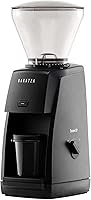
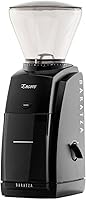
Baratza Encore: Best for mixed brewing routines
- 40 grind settings
- 40 mm conical burrs
- Pulse button and on/off switch
- 1-year warranty
Simple controls suit a household that brews several kinds of coffee. Choose it for mixed use, with extra care over basket compatibility if espresso is your main drink.
Pros
- Simple pulse and on/off controls
- Range covers several brew methods
- Baratza provides a 1-year warranty
Cons
- Broad adjustment range is not a promise of fine espresso control
- Changing brew methods means finding your espresso setting again
Buy the Encore if espresso shares your kitchen with other brewing methods and you want straightforward controls. Its 40 settings and 40 mm conical burrs cover a broad range, while a front pulse button and on/off switch keep operation simple.
The useful distinction is between reaching a fine setting and making small changes around it. A broad range helps you switch brew methods, but it doesn't establish that neighboring positions will give your single-wall basket the adjustment you need.
Skip it as an automatic espresso-first choice if your main goal is precise shot tuning. Read our Baratza Encore espresso guide before choosing, especially if your machine relies on the coffee bed for resistance.
For mixed use, write down a starting setting for each method and expect to refine it for different beans. Baratza backs the Encore with a 1-year warranty, which gives buyers a defined support term alongside its simple operation.
Cuisinart Supreme Grind DBM-8: a better match for batch coffee
Cuisinart Supreme Grind DBM-8: Best for batch coffee households
- 18 grind settings
- Stainless steel flat burrs
- 4 to 18 cup selector
- Automatic shutoff
The cup selector and automatic stop fit households that mainly grind for several servings. Its batch controls make it a less direct match for weighing individual espresso doses.
Pros
- Batch selector with automatic shutoff
- Removable bean hopper and grounds chamber
- Cleaning brush and scoop included
Cons
- Cup selector starts at 4 cups
- 18 positions span several brew methods rather than espresso alone
Choose the Cuisinart when several servings of brewed coffee are your main task and espresso is secondary. Its 4 to 18 cup selector and automatic stop fit batch preparation more naturally than weighing one basket at a time.
The stainless steel flat burr mill has 18 grind positions across fine and coarse brewing. Those positions cover several methods, so don't assume the full count represents small espresso adjustments.
A removable 8 oz hopper and a grounds chamber sized for up to 32 cups reduce interruptions during larger batches. The chamber's capacity is a convenience for collection, not a reason to grind several days of coffee ahead.
Skip it if your main purchase goal is repeated individual espresso doses. Cup labels are not basket weights, so you would still need to measure the output and work around controls aimed at batch brewing.
For that use, compare more targeted choices in our guide to the best espresso coffee grinders.
OXO Brew Compact Conical Burr: small-space grinding with easy access
OXO Brew Compact Conical Burr: Best for small kitchens
- 15 settings and 29 micro-adjustments
- 50 g capacity
- 3.75 x 3.75 x 10.75 in
- Upper and lower burrs come apart
A narrow body suits small counters and modest batches. Accessible burrs and a pouring spout help with cleanup and transferring grounds.
Pros
- Small counter footprint
- Main settings plus micro-adjustments
- Upper and lower burrs come apart for cleaning
Cons
- Small hopper needs refilling for larger batches
- Grounds container adds a transfer step before filling a basket
Choose the OXO when counter space is the constraint you can't change. Its 3.75 x 3.75 x 10.75 in body leaves more room for the machine, scale and basket preparation than a wider grinder would.
You get 15 main settings and 29 micro-adjustments, plus a 50 g hopper for smaller grinding sessions. That capacity suits modest batches; repeated refilling becomes a tradeoff if several people need coffee in quick succession.
The grounds container has a pouring spout, which helps transfer grounds into another vessel. For espresso, allow room to fill and distribute the basket rather than expecting the container alone to prevent spills.
Skip it if keeping a larger quantity of beans loaded matters more than saving space. Its accessible, removable upper and lower burrs are useful for care, but micro-adjustment counts still don't establish shot performance with your particular basket.
Use our coffee grind size chart to understand the broad differences between brew methods before making smaller changes.
Shardor Conical Burr Espresso Grinder: controls for a portafilter routine
Shardor Conical Burr Espresso Grinder: Best for direct espresso dosing
- 51 grind settings
- Portafilter cradle
- Timer adjusts in 0.1-second increments
- Anti-static technology
The cradle, dosing ring and fine timer steps fit a routine centered on filling a portafilter. Weigh the output when setting the timer, since grinding time does not measure dose weight.
Pros
- Portafilter cradle and dosing ring included
- Small timer increments
- Residual grounds cleaner and brush included
Cons
- Portafilter fit needs checking
- Timed dosing still needs calibration with a scale
Choose the Shardor if you want to grind into a portafilter and adjust output through timed runs. The cradle and dosing ring suit a routine centered on filling an espresso basket with fewer transfers.
It has 51 grind settings and a timer that runs up to 60 seconds in 0.1-second increments. Those small timer steps help refine duration after you establish a dose, but they do not measure coffee weight or change grind size.
Check cradle fit before buying. SHARDOR also describes using the dosing ring when a portafilter doesn't fit the cradle, so consider whether that alternative suits the way you hold and fill your basket.
Skip it if you prefer a basic switch and don't want to calibrate timed output. SHARDOR says its anti-static system reduces chamber mess; a residual grounds cleaner and brush are included for maintenance.
Our guide to what grind size works best for espresso explains the grind changes you'll make separately from timer adjustments.
AMZCHEF 48-Setting Burr Grinder: shared use with several control modes
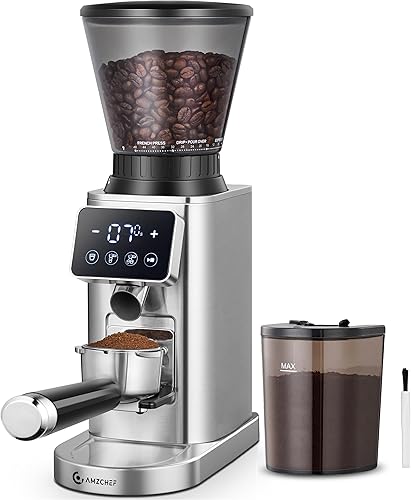
AMZCHEF 48-Setting Burr Grinder: Best for busy shared kitchens
- 48 grind settings
- 40 mm stainless steel conical burrs
- 10.6 oz hopper
- Touchscreen timer
A larger hopper and several control modes suit people sharing one grinder. Its removable hopper has a trap door to help contain beans during removal.
Pros
- Larger hopper for shared use
- Timed, cup selection and manual modes
- Supports specified portafilter sizes
Cons
- 51 mm portafilters require pads
- Portafilters over 58 mm are not supported
Choose the AMZCHEF if several people share the grinder and prefer keeping more beans ready. Its 10.6 oz removable hopper has a trap door designed to limit spills when you lift it away.
The touchscreen offers cup selection, manual operation and timed runs up to 40 seconds in 0.5-second steps. Decide which mode you'll use most, since extra controls are useful only if they make the routine easier to repeat.
Portafilter fit needs attention: 51 mm requires pads, while 54 and 58 mm can be used directly. Portafilters larger than 58 mm are not supported.
Skip it if you change beans for nearly every drink or mainly want the simplest possible controls. A larger hopper is most useful when the household shares beans rather than constantly emptying and refilling it.
AMZCHEF says its anti-static system and stainless steel container help reduce cling. Keep a small brush nearby anyway, since reduced static doesn't remove the need for regular cleanup.
What should you check before buying a budget espresso grinder?
Check basket type and useful fine adjustment first, then decide how you'll weigh and transfer each dose. These choices affect espresso more directly than a large hopper or a long list of control modes.
Start with a pressurized or single-wall basket
A pressurized basket uses an outlet restriction to help create resistance. It is generally more forgiving of grind differences, making it a more practical starting point for a general-purpose budget grinder.
A single-wall basket relies more on the ground coffee itself to control flow. You need both enough fineness and small enough adjustments to move between a shot that rushes through and one that barely flows.
Check the basket instructions for your machine rather than judging by the appearance of the handle. If single-wall espresso is your goal, prioritize adjustment around the working setting before cup selectors, screens or hopper size.
Compare useful steps, not the largest number
A setting count describes available positions across the grinder's range. It doesn't tell you how many fall near espresso or how much the gap changes between neighboring positions.
This is why a grinder with more positions is not automatically the better espresso choice. Avoid assuming that 48 broad settings must offer finer control than a smaller range with micro-adjustments.
For the Encore in particular, keep the model names straight. The Baratza Encore versus Encore ESP comparison helps separate the two before you buy.
Separate dose weight from grinding time
A timer tells the grinder how long to run. The weight it produces can change with the beans, grind setting and feeding conditions, so calibrate output rather than assuming the same duration always means the same dose.
Use a scale that can weigh your basket dose accurately. Recheck after changing beans or grind size, then adjust time if needed to return to your chosen weight.
Plan the transfer and working space
A cradle can remove a container-to-basket transfer, but fit includes more than basket diameter. The handle and basket assembly also need to sit securely in the holder.
Measure space for removing the hopper and handling the grounds container. Leave a clear place for a scale and basket preparation so the grinder doesn't crowd out the tools that make your dose repeatable.
Our espresso grind size guide covers adjustment in more detail. For the basic grinding mechanism, see our burr versus blade guide.
How do you set up a budget grinder for espresso?
Start with one coffee, a measured dose and the basket maker's guidance, then change one variable at a time. This gives each shot a clear purpose and keeps you from chasing several moving targets.
Assemble the grinder before adding beans
Read the grinder's instructions, fit the hopper and container securely, and check that all removable parts are in place. Don't force a control or bypass an interlock if the grinder won't start.
On the AMZCHEF, an E3 message indicates that the hopper isn't locked. Position it correctly and rotate it clockwise until it locks before trying again.
Follow the model's instructions for changing grind size, especially toward finer settings. Some grinders require the motor to run during certain adjustments, so don't apply one model's procedure to every grinder.
Establish a starting recipe
Use the basket's recommended dose range and a recipe suited to your coffee. As a general starting point, many espresso recipes use about twice the beverage weight as the dry coffee weight.
For example, an 18 g dose might start with a 36 g beverage target, if the basket supports that dose. Treat that as a starting recipe, since coffee style and basket size can call for a different ratio.
Keep the dose and beverage target fixed while you find a workable grind. Record the setting and result so the next change has a useful reference.
Adjust flow, then check flavor
If the shot rushes through and tastes thin or sharp, try a slightly finer grind while holding dose and preparation steady. If it barely flows, move a little coarser.
Uneven distribution can also cause fast or erratic flow. Spread the grounds evenly and tamp level before deciding that grind size is the only problem.
Taste the result rather than chasing one universal shot time. Once flow is manageable, small changes in beverage yield can help you refine the balance without immediately changing the grinder again.
Calibrate the timer last
Find the grind setting and dose first, then set a timed run to produce roughly that amount. Weigh the output and make small duration changes as needed.
Check the dose again after a meaningful grind adjustment. Finer grinding can change output per second, so a timer setting that worked yesterday may need a small correction.
How do you share one grinder between espresso and filter coffee?
Record separate starting settings and recipes for each brew method, and allow for grounds left from the previous setting. Sharing can work well, but returning to a number is a starting point rather than a promise of an identical shot.
Keep a short note with the coffee, espresso dose, beverage yield and grind position. A separate note for drip or French press saves you from rebuilding the routine each morning.
After a large setting change, some grounds from the previous grind may remain inside. Follow the grinder's instructions for clearing residual coffee, and consider that carryover when judging the first dose.
A dedicated espresso grinder becomes more useful when several people keep changing settings or when wasted coffee offsets the saving from sharing. Make that decision around your household's routine rather than buying a second grinder by default.
How should you clean a budget espresso grinder?
Remove loose grounds and coffee oil buildup regularly, using the cleaning method approved for each part. Unplug the grinder before removing burrs or reaching into the grinding area.
Brush accessible grounds from the burr area, outlet and container. Clean sooner if you notice buildup, a stale smell or grounds obstructing the path.
Keep burrs and the motor housing dry unless the instructions explicitly allow another method. Never pour water through the grinder to flush out coffee.
For the OXO Compact, wipe the body and hopper with a soft, damp cloth. Wash the grounds container with soap and water, then dry it thoroughly before reuse.
Don't assume every removable part is dishwasher-safe. Check the instructions for the exact part, and let washed containers dry fully before putting them near dry beans or grounds.
Our burr grinder cleaning guide explains the broader care routine. After reassembly, confirm that everything is seated correctly before restoring power.
Which mistakes make budget espresso grinders harder to use?
The biggest mistakes are changing several variables at once, trusting volume labels as dose weights and expecting features to solve preparation problems. A simple, repeatable routine usually helps more than frequent changes to every control.
Changing grind, dose and yield together
If all 3 change between shots, you won't know which change improved the cup. Keep 2 steady while adjusting the third, and write down the result.
Avoid using extra coffee to compensate for a grind that's much too coarse. Overfilling can reduce space above the coffee bed and make basket preparation harder.
Treating a cup selector as an espresso recipe
Cup selections estimate output for brewed coffee routines; they aren't a direct measure of the grams your basket needs. Weigh the grounds rather than matching a cup number to a shot count.
The same applies to scoops. Coffee volume changes with grind size and how tightly it settles, so weight gives you a more repeatable starting point.
Blaming every poor shot on the grinder
Uneven grounds distribution, an unsuitable dose or inconsistent tamping can cause problems even at a sensible grind setting. Check those basics before making a large adjustment.
Coffee also changes as it ages, so an established setting may need a small shift over time. Keep beans sealed between uses and grind close to brewing rather than storing a large batch of grounds.
Expecting anti-static controls to remove every stray ground
Static reduction helps with handling, but it doesn't replace careful transfer and cleaning. Keep the basket centered, use the included dosing ring where appropriate and brush away residue before it spreads across the counter.
Which budget espresso grinder should you choose?
Choose the best budget espresso grinder for your basket and daily workflow, then judge convenience features around that need. A general-purpose grinder makes sense for mixed brewing, while an espresso-first routine calls for closer attention to fine adjustment.
Pick the Encore if you want simple controls and several brew methods. Pick the Cuisinart when batch coffee is the main job, or the OXO when a small footprint matters most.
Choose the Shardor if direct portafilter dosing and timer control fit your routine. Choose the AMZCHEF if a shared hopper and several operating modes solve a daily need.
Before ordering, identify your basket type and decide how you'll weigh each dose. Use our espresso grind size guide to plan the adjustments you'll make once the grinder arrives.
Our top 3 picks at a glance
-
1
-
2
-
3
Frequently asked questions
Can a budget grinder make espresso?
Yes, if its fine range and adjustment steps suit your basket and beans. A pressurized basket is generally more forgiving than a single-wall basket, which depends more on the coffee bed for resistance.
An espresso label or a high setting count does not establish that match.
Is the Baratza Encore good for espresso?
The Baratza Encore is a mixed-use option with espresso included in its grind range. Choose it for simple controls across several brew methods, and check basket requirements before making it your espresso-first choice.
Our Baratza Encore espresso guide explains the decision in more detail.
What matters most in an inexpensive espresso grinder?
Useful adjustment near your espresso setting matters most, followed by a repeatable dose and a workflow you can manage each morning. Check your basket type before comparing extras.
A cradle reduces transfers, while a timer controls grinding duration; neither replaces the need to weigh grounds during setup.
Do I need a separate grinder for espresso?
No, but a dedicated grinder lets you leave the espresso setting in place. Sharing one grinder with coarse brewing means recording settings and allowing for grounds left from the previous grind.
Our espresso grind size guide explains how to make useful adjustments without changing several variables at once.