What Makes a Good Coffee Grinder?
What makes a good coffee grinder is consistent grounds and useful adjustment for your main brew method. Choose controls, batch capacity and cleaning access that make your daily routine easy to repeat.
On this page (10 sections)
- What makes a good coffee grinder for your brew method?
- Why do burrs matter more than a long settings list?
- How many grind settings and adjustments are enough?
- How much hopper capacity do you need?
- Which coffee grinder features fit these four routines?
- What should you check for counter space and daily use?
- How do you set up a coffee grinder for repeatable results?
- How do cleaning and care affect coffee quality?
- Which common mistakes should you avoid?
- Which coffee grinder should you choose?
What makes a good coffee grinder is consistent grounds, useful grind adjustment and a routine you can repeat. Choose for the coffee you brew most often, then check batch capacity, controls, cleaning access and kitchen space.
For drip coffee or French press, you need useful control across medium or coarse sizes. Espresso puts more weight on small adjustments because the grounds help control how quickly water moves through the coffee.
The four grinders below suit different routines, from repeated household batches to careful espresso adjustments. Our complete burr coffee grinder buying guide explains the wider category if you're still deciding which features matter.
What makes a good coffee grinder for your brew method?
A good grinder reaches your brewer's working grind range and lets you adjust within it. Start with your everyday method, rather than buying around a brew style you might try someday.
| Brew method | Starting grind range | What matters most |
|---|---|---|
| Espresso | Fine | Small adjustments to control flow |
| Pour over | Medium-fine to medium | Repeatable changes for flow and flavor |
| Drip coffee | Medium | Easy adjustment around your brewer's needs |
| French press | Medium-coarse to coarse | Consistency and control over sediment |
| Cold brew | Coarse | Batch capacity and a suitable coarse range |
These ranges are starting points. Brewer design, filter type, beans and steeping time can move the right setting in either direction.
Our coffee grind size chart helps you choose an initial range. After that, judge the brewed coffee and change one thing at a time.
Espresso needs extra care because reaching a fine grind is only part of the job. With a nonpressurized basket, you also need small enough changes to adjust shot flow without jumping past the setting you want.
A pressurized basket is generally more forgiving of grind differences. If you're moving toward a nonpressurized setup, prioritize adjustment now; our espresso grind size guide explains how to dial it in.
Why do burrs matter more than a long settings list?
Burrs give you control over grind size by passing beans between grinding surfaces set a chosen distance apart. Blade grinders chop beans repeatedly, so longer grinding changes the mix of particle sizes without giving you the same defined adjustment.
Ground coffee always contains a range of particle sizes. The goal is to limit extremes, since very small particles extract quickly while larger pieces extract more slowly.
Too many fines can slow a paper-filter brew or add sediment to immersion coffee. A mix of very fine and very coarse pieces can also make flavor harder to correct with a single grind change.
Conical and flat burrs can both serve home brewing. Shape alone is not a reason to choose a grinder that lacks the adjustment or controls your routine needs.
For the mechanism, read what a burr grinder is and how it works. Our conical vs flat burr grinder guide explains the design differences.
Burr diameter is another comparison point, but it doesn't establish grind quality by itself. All four examples here use conical burrs, so the more useful buying differences are adjustment, batch handling and daily operation.
How many grind settings and adjustments are enough?
You need useful changes within your preferred range, not a target setting count. A grinder with many positions can still be awkward for espresso if each change moves the grind too far.
Stepped controls give you fixed positions that are easy to record and revisit. They suit a routine where you switch between a few familiar recipes.
Stepless controls move continuously, allowing smaller changes between positions. That helps with espresso, though you'll need to note dial positions carefully when switching methods.
Micro-adjustments add choices around the main settings. Compare how you reach those choices, since a large count means little if you find the adjustment process awkward.
What makes a good coffee grinder easy to dial in?
Clear reference points and repeatable controls make a grinder easier to dial in. Keep a short note of the bean, dose, grind position and brew result so you can make a useful next change.
A grind number is not a universal recipe. The same number on different grinder models can produce different grounds, and even familiar beans may need adjustment as they age.
For filter coffee, move a little finer if the cup tastes thin or sour, or a little coarser if it tastes harsh or drains too slowly. Keep the dose, water amount and brewing method steady while you judge that change.
How much hopper capacity do you need?
Choose capacity by the weight of your normal batch, not a vague cup count. Coffee cup sizes vary, and your preferred coffee-to-water ratio determines how many beans you need.
For example, a 1:16 ratio uses 30 g of coffee for 480 g of water. A household brew using 60 g of beans needs more hopper room, or an extra refill, even if both recipes sound like “a few cups.”
A larger hopper helps when several people brew in succession. It doesn't need to stay full, and it shouldn't become long-term bean storage.
Keep the main supply sealed away from heat and light, then add a practical amount for your routine. A tinted hopper can reduce light exposure, but it doesn't remove the other reasons to store beans carefully.
If you switch between regular coffee and decaf, adding one measured dose at a time can simplify bean changes. Our guide to single-dose coffee grinders explains this workflow and why leftover grounds matter.
Which coffee grinder features fit these four routines?
Choose the grinder whose controls and capacity solve your daily constraint. These four options illustrate different priorities, so each has a clear buyer and a reason to pass.
OXO Brew Conical Burr Grinder: for repeated household batches
The OXO Brew Conical Burr Grinder suits a household that wants to refill less often and repeat a familiar morning routine. It combines a removable 12 oz hopper with a one-touch timer that remembers the last time setting.
Its 40 mm stainless steel conical burrs have 15 main settings plus 43 micro-adjustments. OXO describes a range from fine espresso grounds to coarse grounds for French press and cold brew.
The UV-blocking hopper tint helps shield beans from light. Keep only a practical supply inside, especially if the grinder sits near a warm appliance or a sunny window.
Choose it for repeated batches when a remembered timer would save a daily step. Remember that a timer repeats duration, not the weight of coffee delivered, so weigh the grounds when setting up a recipe.
Skip it if compact storage is your priority or espresso precision is the main reason you're buying. Its 12.9 in height also needs extra clearance above it for adding beans and removing the hopper.
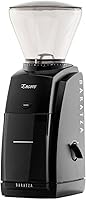
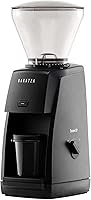
Baratza Encore: for straightforward filter-coffee routines
The Baratza Encore suits someone who wants fixed grind positions and direct controls for everyday brewing. Its front pulse button and on/off switch let you choose between short bursts and continuous grinding.
The Encore has 40 settings and 40 mm conical steel burrs. Baratza describes its range for methods including espresso, pour over, French press and automatic brewers.
Choose it for a filter-first routine if you want to record a numbered position and control when grinding stops. Weighing beans before grinding can make that simple control layout easier to work into a repeatable recipe.
Skip it if you want automatic stopping to be part of your workflow. For an espresso-first setup, compare adjustment needs in our espresso grinder guide before choosing based on range alone.
Its footprint is 5.91 x 5.12 in, with a height of 13.39 in. Baratza backs the Encore with a 1-year warranty, a useful ownership detail to consider alongside controls and fit.
OXO Brew Compact Conical Burr: for small kitchens and modest batches
The OXO Brew Compact Conical Burr suits a small counter or a routine built around one modest batch. Its body measures 3.75 x 3.75 x 10.75 in, making the space requirement easy to check before ordering.
It uses stainless steel conical burrs with 15 settings and 29 micro-adjustments. The grounds container includes a pouring spout, which helps guide grounds into a brewer with a narrow opening.
Choose it when storage and cleaning access matter most. Its upper and lower burrs come apart for cleaning, and the chuteless design gives you access to the grinding area.
Skip it if your usual batch exceeds 50 g and you want to load all the beans at once. Repeated refilling is a small chore that can become tiresome when several people need coffee.
OXO directs you to wipe the body and hopper with a soft, damp cloth. The grounds container can be washed with soap and water, then dried thoroughly before reuse.
Fellow Opus 2: for espresso adjustments and changing brew methods
The Fellow Opus 2 suits someone who wants small espresso adjustments while also brewing filter coffee or immersion coffee. Its stepless control lets you move between positions without fixed steps.
The Opus 2 has 48 mm conical burrs, automatic shutoff and a grind guide under the lid. Fellow says its anti-static technology reduces clinging grounds and its low-retention design limits coffee left inside between brews.
Two magnetic catch cups are included. The espresso cup supports transfer to 54 mm and 58 mm portafilters, while the other cup serves coarser grounds.
Choose it if fine adjustment is worth keeping recipe notes. Record dial positions for each brew method so switching from espresso to cold brew doesn't leave you starting from scratch.
Skip it if you strongly prefer fixed numbered stops and rarely change your brewing recipe. Tool-free burr access helps with care, and Fellow includes a 2-year standard warranty.
What should you check for counter space and daily use?
Measure working space as well as the grinder's body. You'll need room to load beans, remove the grounds container and reach any parts involved in cleaning.
Check overhead cabinets before buying a tall model. A grinder can fit underneath yet still need to be pulled forward every time you fill it.
Leave enough space beside the grinder for a scale, beans and your brewer. If you plan to store it after each use, consider its weight and cord storage along with its dimensions.
Match controls to your habits, too. A remembered timer helps a repeated routine, a pulse button gives direct control, and automatic stopping removes one task from the process.
None of those controls replaces measuring the dose when accuracy matters. Different beans and grind settings can change how much coffee comes out during the same grinding time.
How do you set up a coffee grinder for repeatable results?
Start with a measured dose and a middle-of-range setting for your brew method. A simple baseline makes flavor changes easier to understand.
- Read the setup directions and check that removable parts are seated correctly.
- Place the grinder on a dry, stable surface with room to handle the grounds.
- Weigh the beans for your chosen recipe.
- Choose an initial grind position from the grinder's guide or your brew chart.
- Brew with a measured amount of water.
- Record the result and change only one variable for the next brew.
Follow the grinder's directions when changing settings, particularly when moving finer with beans inside. Don't force an adjustment dial against resistance.
When switching between very different grind sizes, some grounds from the previous setting may remain inside. A small clearing dose can help, but follow the model's instructions and avoid wasting more coffee than needed.
For espresso, hold dose and beverage yield steady while adjusting grind to change flow. For filter coffee, keep pouring or steeping technique steady so you can judge the grinder change fairly.
How do cleaning and care affect coffee quality?
Remove old grounds and coffee oils regularly to keep the grinding path clear and reduce stale carryover. Cleaning access deserves attention before buying because awkward access can turn routine care into a chore.
Unplug the grinder before opening the burr area. Use the brush and cleaning method allowed by the manufacturer, and avoid putting fingers near moving parts.
Don't assume removable burrs can be rinsed or put in a dishwasher. Keep water away from the motor and burr assembly unless the instructions expressly allow it.
Wash only the parts approved for washing, then dry them fully before reassembly. Damp grounds can stick inside the grinder and make the next cleaning harder.
Clean more often if you change beans frequently or notice old grounds building up. Our guide to how to clean a burr coffee grinder walks through the general process.
Use a coffee grinder for coffee unless its instructions permit other ingredients. Spices can leave strong flavors, and unsuitable ingredients can clog the grinding path.
Which common mistakes should you avoid?
The biggest mistakes are buying around one headline spec and changing too many brew variables at once. Both make it harder to get the benefit of a new grinder.
- Choosing by setting count alone: useful spacing in your brew range matters more than the total.
- Assuming “fine” guarantees espresso control: small adjustments matter when dialing in a nonpressurized basket.
- Confusing grinding time with dose: use a scale to establish how much coffee your routine produces.
- Filling the hopper for storage: add what you'll reasonably use and keep the remaining beans sealed.
- Changing grind, dose and water together: adjust one variable so the result teaches you something.
- Ignoring working clearance: leave room to refill, pour and clean, not just room for the base.
- Trying to correct stale beans with grind changes: a grinder can adjust extraction, but it can't restore freshness.
Avoid chasing an exact grind number from someone else's recipe. Use it as a starting point, then adjust for your own beans, brewer and taste.
Which coffee grinder should you choose?
What makes a good coffee grinder for you is the right adjustment paired with a routine you'll repeat. Decide your main brew method first, then let batch size, controls and care settle the choice.
Choose the OXO Brew Conical Burr Grinder for repeated household batches and a remembered timer. Choose the Baratza Encore for a filter-first routine with fixed settings and direct start-stop control.
Pick the OXO Brew Compact Conical Burr when counter space is tight and your normal dose fits its small hopper. Pick the Fellow Opus 2 when continuous adjustment, especially for espresso, is central to your buying decision.
Before ordering, write down your usual bean dose and measure the space where you'll use the grinder. Then use our best burr coffee grinders roundup to compare alternatives against those same needs.
Frequently asked questions
What makes a good coffee grinder for home?
A good home grinder produces consistent grounds and gives you useful adjustments for your main brew method. Choose capacity around the amount you grind at once, then check counter clearance, controls and cleaning access.
For espresso, give fine adjustment more weight than hopper size or the total number of settings.
Are burr grinders better than blade grinders?
Burr grinders are the better choice when you want control over grind size and a recipe you can repeat. Blades chop beans into a wider mix of sizes, making small recipe changes harder to judge.
Our guide to burr vs blade coffee grinders explains the practical trade-offs.
Do bigger burrs make better coffee?
Bigger burrs do not automatically make better coffee. Burr design, alignment and adjustment all affect the grounds, while your beans and brewing recipe shape the cup.
Choose a grinder that fits your brew method and daily workflow before using burr diameter to decide between otherwise suitable models.
How many grind settings do I need?
You need enough useful adjustment to tune your usual brew, rather than a particular number of settings. Fixed steps can make returning to a recipe simple, while stepless adjustment allows smaller changes.
Espresso often needs finer control than drip coffee, so choose around your brewer before comparing setting counts.
Should I choose a large or small coffee grinder hopper?
Choose a hopper that holds your normal batch without repeated refilling. A larger hopper helps when you make several batches, while a smaller one suits limited counter space and measured doses.
You can store beans separately in either case; hopper capacity does not tell you how much coffee to grind.